
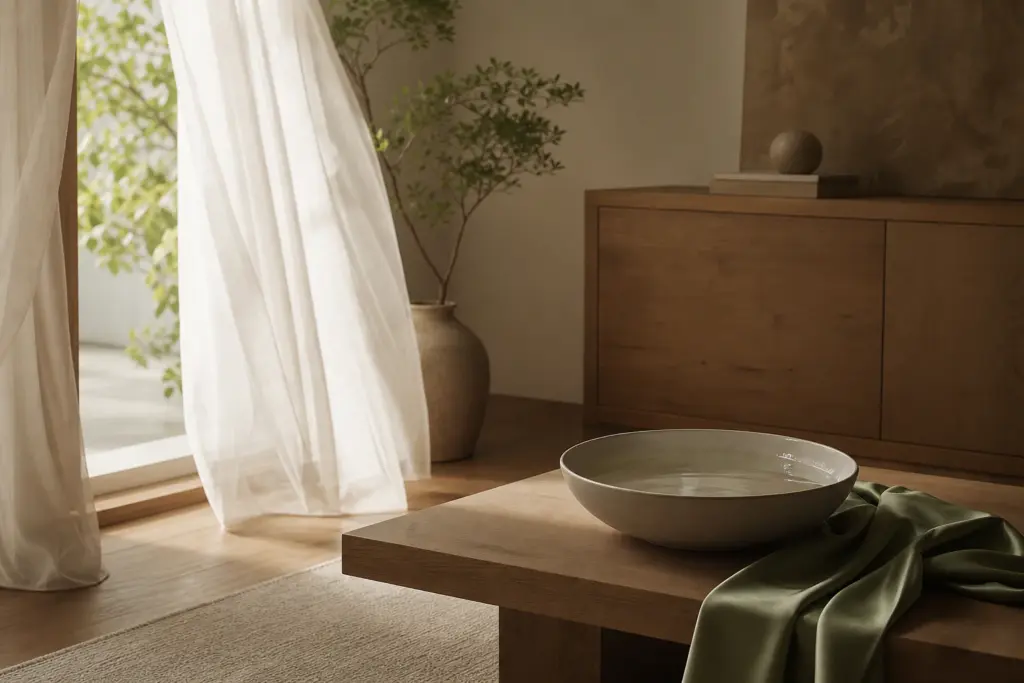
Instagram feng shui is mostly crystals and “wealth corners.” Classical feng shui is older and quieter: a way of talking about how humans sit inside landscape — wind (feng 风), water (shui 水), light, and the directions we face when we work and sleep. This page builds vocabulary so you can read scarf colors, bag materials, and desk rituals as symbolic context, the same way as five phases on wearables.
Feng shui in one paragraph
Feng shui (风水) literally means wind and water: the visible movement of air and the hidden courses of streams. Traditional texts in the burial-and-site lineage (associated with Guo Pu’s Zang Shu, Book of Burial, in scholarly summaries) describe choosing places where qi (气, often translated “vital breath” or “life force”) can gather and move gently, not rush or stagnate. Modern illustrated primers translate that into apartment-friendly language: doors, windows, desk orientation, color in rooms.
Think relationship between person and place, not a single magic object.
Core ideas beginners meet first
Yin and yang (阴阳)
Not “good vs evil.” Yin is shade, rest, softness, interior; yang is light, activity, openness. A bedroom leans yin; a lively kitchen leans yang. On wearables, yin-yang disks are balance symbols.
Qi (气)
Qi is the flowing quality of a space or moment, drafty hallway vs sheltered courtyard. Writers disagree on how measurable qi is; for gift copy, treat it as metaphor for comfort and flow: does this scarf color feel calm on their skin? Does this bag sit right on the commute?
Directions and the bagua
Compass directions (east, south, west, north and the four intermediates) carry symbolic associations in many schools. The bagua (八卦) map overlays eight trigrams, broken and solid lines from the I Ching, onto sectors of a floor plan or plot. Deep dive: Bagua map & eight directions.
How feng shui differs from BaZi and five elements
| Framework | Main question | Typical input | Wearable angle |
|---|---|---|---|
| Feng shui | How does this place feel and function? | Room layout, direction, objects | Desk zone, commute wear, color in space vs on body |
| BaZi (Four Pillars) | What symbolic pattern sits in your birth moment? | Year, month, day, hour | Four Pillars primer, match flow |
| Five phases (Wu Xing) | Which relational category (Wood, Fire, …)? | Charts, seasons, color grammar | Colors on wearables |
| Almanac (通胜) | What does today say for everyone? | Calendar date | Yi / Ji explained |
You can care about all four without collapsing them. A red scarf is a Fire color story; it becomes Kua vocabulary only when you explicitly name direction groups. Kua intro: Kua number & personal directions.
What feng shui is not
- Not a promise to fix luck. No “place this and money arrives” claims.
- Not exorcism marketing. “Block sha evil” trinkets online often sell anxiety; that is a different product from feng shui itself.
- Not a substitute for building codes or medicine. Ventilation matters for health; feng shui language is symbolic layering on top.
- Not identical to interior-design trends. Minimalism can be feng-shui-informed or not; the tradition predates Pinterest.
- Not only about sofas. Scarves, bags, and ties tell the same stories on the body as a mobile space — see the wearable cluster below.
Why a wearable shop cares about feng shui at all
Classical placement talks about color, shape, and material in rooms. The same variables exist on scarves, ties, bags, and hair clips. A wood-toned leather bag echoes the Wood phase material story; a metal buckle echoes Metal. A compass rose print on silk is bagua symbolism, not a GPS for wealth.
When home palette and outfit palette diverge, that is normal — office dress codes exist. I compare layers in feng shui colors: home vs what you wear and five elements in a room.
Suggested reading order
-
Step 1
This page: definitions and boundaries
Separate what feng shui, BaZi, five phases, and the almanac each answer.
-
Step 2
Bagua & directions
Trigram vocabulary and the symbolic map of compass sectors.
-
Step 3
Kua number
Birth-year direction groups — symbolic meaning.
-
Step 4
Five elements in space
How color, shape, and material tell stories at home.
-
Step 5
Colors on body vs wall
How the same hue reads differently at home and on the commute.
-
Step 6
Crystals & symbols you can wear
Coins, crystals, and other portable symbols in gift practice.
-
Step 7
Desk + commute wearables
Color choices that work under office dress codes.
-
Step 8
Body as mobile space
The full wearable gift map — treating the body as a portable feng shui context.
Not every reader needs step eight on day one. Gift buyers can jump from here to what counts as a wearable and pick a scarf + bag combo.
Beginner FAQ
- Do I need a compass to buy a feng shui gift?
- No. Direction-themed patterns are symbolic art. Only advanced practitioners treat literal compass bearing as technical input — outside everyday gift scope.
- Is feng shui religious?
- It grew inside Chinese cosmology and folk practice. Modern readers treat it as cultural aesthetics, ecology metaphors, or personal ritual — there is no single correct answer, and you do not have to believe one way.
- How does this connect to my birth chart?
- BaZi personalizes time; feng shui personalizes place. Overlap appears in Kua groups and color emphasis. With birth date and time, the match flow suggests wearable palettes.
Read next
Further reading (available on Amazon)
Two popular Western introductions that help land the vocabulary from this page in room placement and symbolic language — not luck-fix promises.
The Chinese art of placement
Why we recommend it: Sarah Rossbach translates feng shui from countryside and town sites to indoor furniture — apartment-friendly language that matches this page’s “person and place” frame.

Illustrated feng shui primer
Why we recommend it: Lillian Too’s illustrated guide covers doors, windows, color, and bagua directions — one of the most visual vocabulary references in contemporary popular writing.
